
Salt Lake City's water, sewer and stormwater impact fees are going up for the first time since 1999. The City Council adopted the new fees unanimously on October 6, 2026, and they apply to building permits issued on or after January 4, 2027. For a typical single-family home, these utility impact fees jump from about $2,790 to about $8,309. Townhomes and small apartment projects see smaller but still real increases, and large apartment buildings barely change.
At di'velept, we design housing in Salt Lake City every week, and impact fees are one of the first costs our clients ask us about. This post explains what impact fees are, how SLC has changed them, when the change hits your project, and one design decision that can swing these fees a lot on small projects. A few questions are still open with the city, and we say plainly which ones those are.
What is an impact fee?
An impact fee is a one-time charge a city collects from new development to pay for the public facilities that growth uses. In Utah, impact fees are governed by the Utah Impact Fees Act, which requires the city to show its math in a facilities plan and a fee analysis. You pay them once, when the building permit is issued. They are separate from your monthly utility bills and from the charges for the meter itself.
Salt Lake City really has two sets of impact fees, and that causes a lot of confusion:
General impact fees cover parks, roads, fire and police. You pay them to Building Services on the Impact Fee Worksheet. These did not change. They are $5,832 per single-family home and $3,550 per apartment unit.
Utility impact fees cover water, sewer and stormwater. You pay them to Public Utilities. These are the ones that went up.
Part of the confusion is that the city's current fee schedule lists water and sewer impact fees as "connection fees," so many owners never thought of them as impact fees at all. The new ordinance moves them into the impact fee section, where they belong.
How much did Salt Lake City's utility impact fees go up?
Water and sewer impact fees are now both charged by the size of your water meter, and stormwater is charged by site area. The Council adopted the fees at 70% of the maximum the city's analysis supports. Here is what changes for the most common meter sizes:
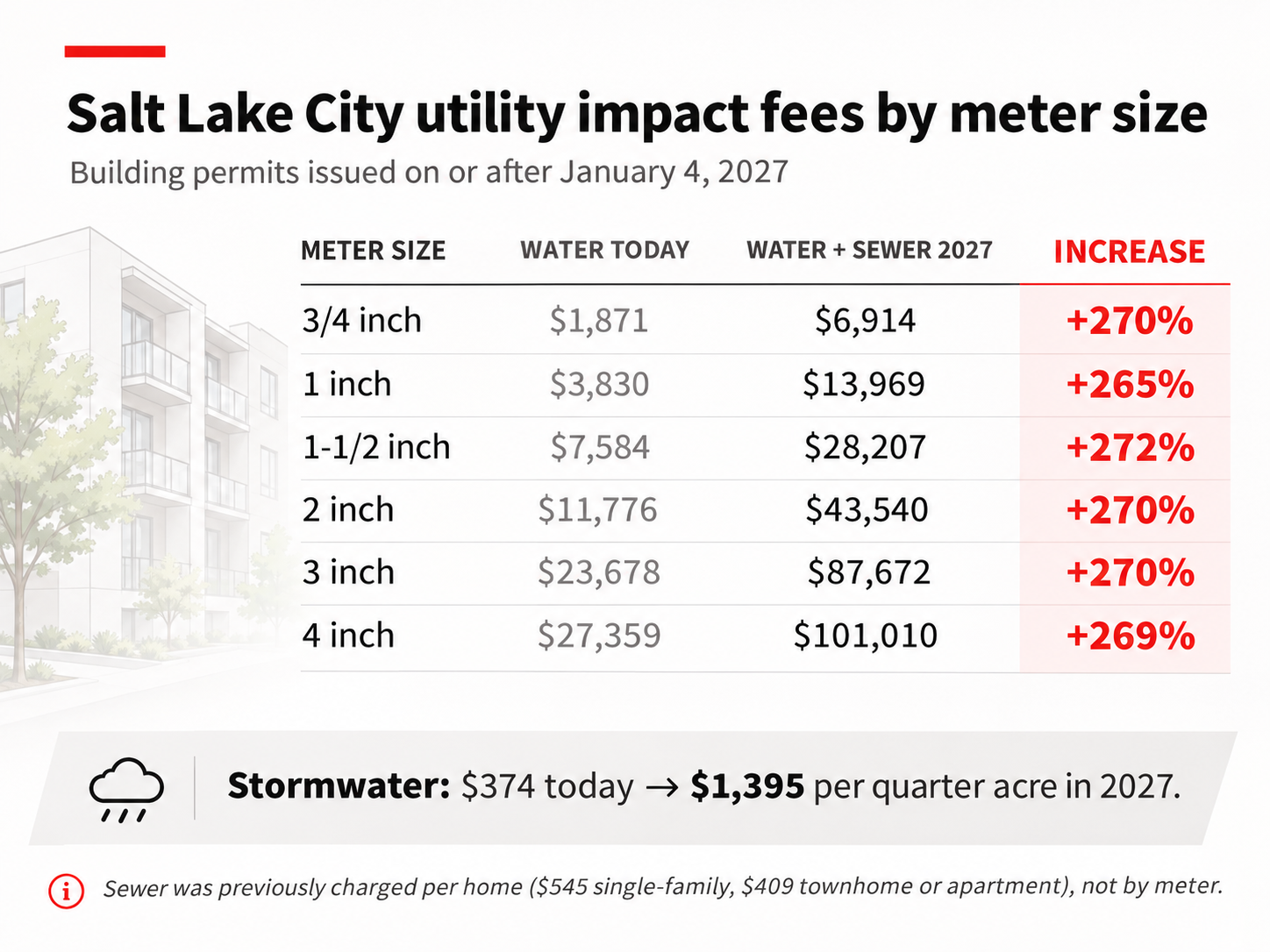
The sewer impact fee is not new, but it used to be charged per home: $545 for a single-family house and $409 per townhouse or apartment unit. Now it follows the meter. Stormwater goes from $374 to $1,395 per quarter acre of site, rounded up.
For a single-family home on a quarter-acre lot with a 3/4-inch meter, the math is $3,904 water + $3,010 sewer + $1,395 stormwater = $8,309, up from $2,790 today. Add the unchanged $5,832 in general impact fees and the total is about $14,141 per new home.
The full adopted fee table, including meters up to 10 inches, is in Exhibit C of the October 6, 2026 Council meeting packet.
When do the new fees apply to my project?
The new fees apply to building permits issued on or after January 4, 2027. Utah law says an impact fee can't take effect until 90 days after the city adopts it, and 90 days after October 6 is January 4. Some news coverage said January 1, but the ordinance and state law point to the 4th.
The fees are paid when your building permit is issued. What we don't know yet is whether a project that applied before January 4 but gets its permit after will pay the old fees or the new ones. We have asked the city and haven't gotten a clear answer. Until we hear back, we would plan on the new fees for any permit issued on or after January 4.
The 70% level is also not the end of it. The Council said it intends to consider raising the fees to 100% by July 1, 2028. That has not been adopted and will need its own vote. Still, if you are just starting a big project, it may not be permitted until 2028, so we recommend budgeting for the 100% numbers. For that same single-family home, 100% would be about $11,870 in utility impact fees.
Meter size is the biggest lever you control
On small projects, meter size drives the utility impact fees far more than unit count does. Salt Lake City Public Utilities allows one meter per property. So almost every townhome project we design in the city shares one culinary meter for the whole group, whether the homes are sold or rented. A typical project has three water lines: a culinary meter sized by the plumbing engineer, a landscape irrigation meter, and an unmetered fire sprinkler line. The fire line does not pay an impact fee.
Here is what one meter size can do to the per-home cost at the January 2027 rates. These are our own estimates using the adopted fees, with stormwater included:
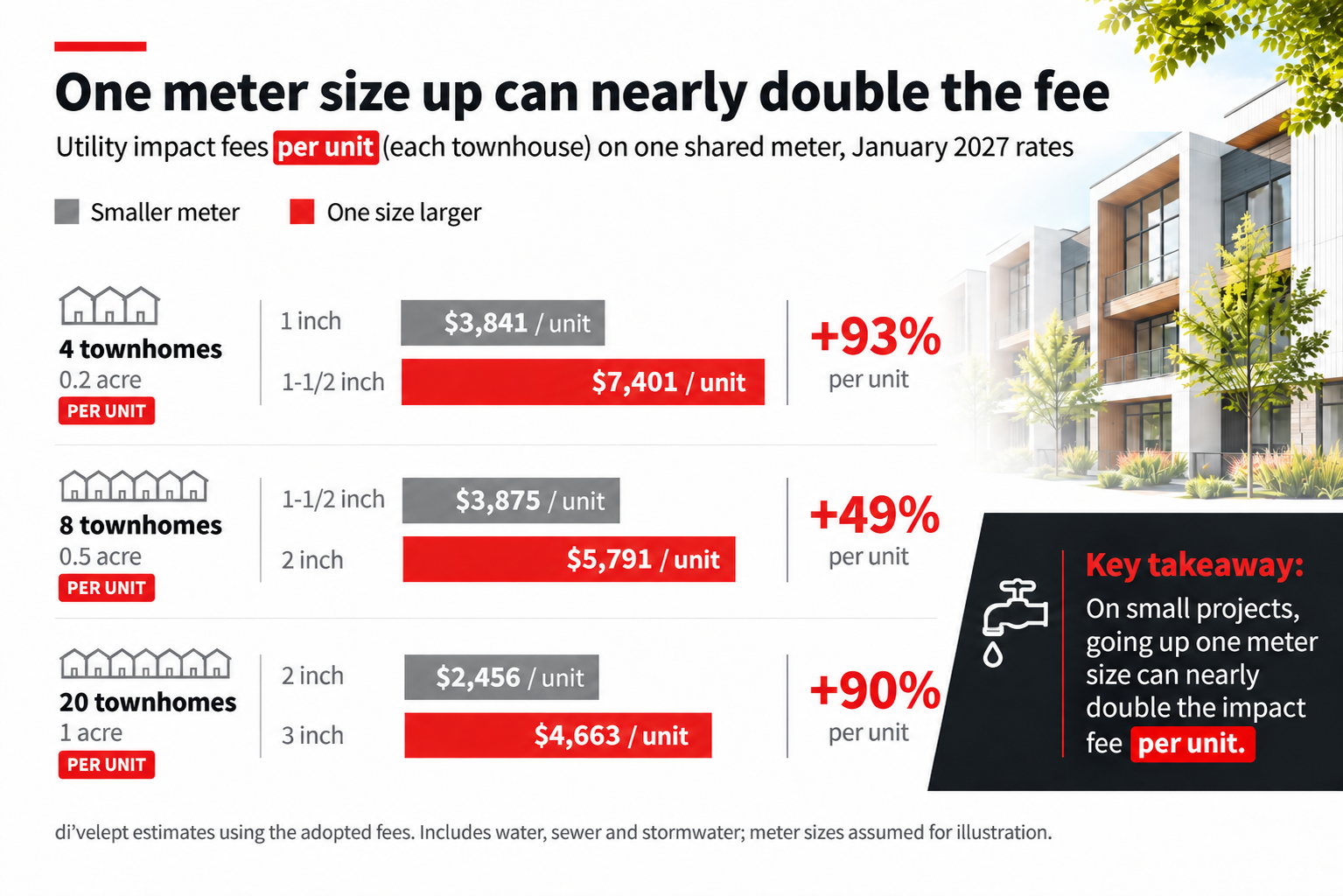
On the four-townhome project, going up one meter size nearly doubles the cost per home. That one decision can cost more than the whole fee increase.
That makes unit design part of the fee conversation. The meter is sized from the plumbing demand of every home on it, and each bathroom, tub and fixture adds to that demand. We look carefully at fixture counts early in design. On a small project, keeping the meter one size smaller can save thousands of dollars per home.
The irrigation meter matters too. Public Utilities confirmed to us that the sewer impact fee is charged only on the culinary meter. An irrigation meter pays the water impact fee but not sewer. You are allowed to run irrigation through one combined meter, but on an eight-townhome example on a half acre, a separate 1-1/2-inch culinary meter and 1-inch irrigation meter came to about $38,800. One combined 2-inch meter came to about $46,300.
The rule of thumb we now use: combine only if the culinary meter can carry the irrigation load without going up a size. Irrigation usually runs at night when household use is low, so sometimes it can. If combining bumps the meter a size, keep them separate. Either way, work through it early with your plumbing engineer and landscape architect, before the meter size is locked in.
What we are still asking the city
We have asked Salt Lake City two questions that could change real money on some projects. City staff have told us they are working on answers, and that these questions are helping them prepare for the January rollout. We will update this post when we hear back.
1. Does the affordable housing exemption now cover utility impact fees? Salt Lake City already lets qualifying affordable units skip the general impact fees, under City Code 18.98.060.E, through the Housing Stability Division. The old water and sewer fees had no such exemption. The new ordinance moves the utility impact fees out of the Public Utilities connection fees and into the impact fee section of the city's fee schedule, and says they are administered under Chapter 18.98, the same chapter as the exemption. If the exemption now applies to them, an affordable project could actually pay less by having its permit issued after January 4 rather than before. Until the city confirms, we would not plan on it either way.
2. How long does an existing meter's credit last? If you tear down a building that already had water service, you usually get credit for that connection. But the city has two different clocks in its code. The water code gives residential service a five-year window after demolition. The general impact fee chapter gives credit only for buildings demolished within the prior 12 months. The new ordinance doesn't say which one applies to the new utility fees. On a 3/4-inch meter, that difference is worth about $7,000 at the January 2027 rates. If you are planning a teardown, we suggest keeping the demolition and the new permit within 12 months until this is settled.
Building outside Salt Lake City on city water
Salt Lake City's water system also serves parts of Millcreek, Holladay, Cottonwood Heights, Murray, Midvale and South Salt Lake. If your project is in one of those areas and connects to Salt Lake City water, you pay the city's new water impact fee. You do not pay its sewer or stormwater fees, because a different provider handles those where you are. That provider has its own impact fees.
This matters because a large share of the new sewer fee pays for the city's new water reclamation plant. Outside-city projects on city water don't pay for that part.
Why the city raised them, and what it leaves out
The city's case is reasonable. These fees had not changed in 27 years, through a lot of growth, inflation and rising construction costs. State law now requires a formal facilities plan and fee analysis, which the city completed in late 2025. Council members said they want growth to pay for growth, so that existing ratepayers are not covering capacity for new buildings. At di'velept, we agree the fees were overdue for an update.
Where we think the story is incomplete is the claim that new fees simply keep existing users from subsidizing growth. Each fee has two parts. "Improvement" pays for new capacity the city plans to build. "Recoupment" is new development buying into capacity the system already has. The city's own analysis compares that split with peer utilities, and Salt Lake City leans much harder on recoupment:
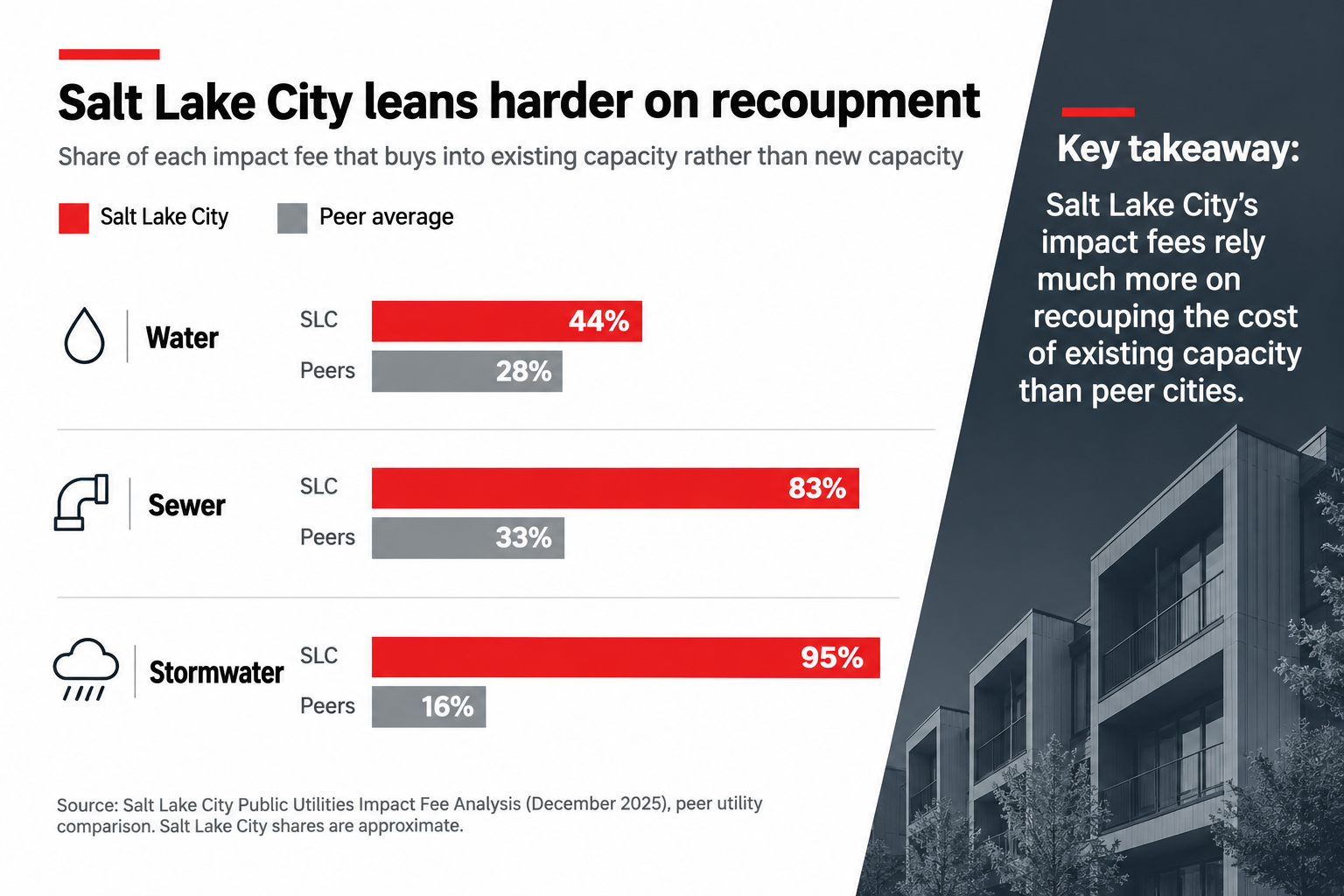
Much of the sewer recoupment is the city's new water reclamation plant, roughly an $850 million project. The city's own Impact Fee Facilities Plan says the work underway at the treatment plant will not expand its capacity, and the plant already has extra capacity: it is rated at 56 million gallons a day and currently uses about 42. New homes do use some of the old plant's spare capacity, but the plan prices that capacity at the full $850 million cost of the new plant. That puts about $27.5 million of the rebuild on new development over the next six years. Growth isn't getting new treatment capacity, but it is paying for a share of the replacement at new-construction cost. Older homes in the city never paid a buy-in like this. They have paid for their water and sewer use through monthly rates, sometimes for a hundred years. New homes will pay those same monthly rates, and they are also being asked to pay up front for a share of the existing system.
There is a second piece. In our experience, nearly every project in Salt Lake City gets a capacity review from Public Utilities. If the local system doesn't have enough extra capacity to handle the new load, the developer pays to upsize the water or sewer main. Those upgrades often serve the neighbors too. In theory, if a later development connects to that upgraded line, the first developer should get part of the cost back. In practice, we have rarely seen that happen.
None of this makes the update wrong. It just means new development is already carrying more of the system than the "no subsidy" line suggests. And like any development cost, these fees end up in the price buyers pay and the rent tenants pay.
What to do now
If you are planning a project in Salt Lake City or on city water, here is our short list:
Know your permit date. Permits issued before January 4, 2027 pay today's fees. If your project is in review before then but the permit is issued after, which fees apply is still an open question. Also, don't assume a December review will be quick.
Budget for 100% if your project won't be permitted until 2028 or later.
Size the meter early. Ask your plumbing engineer what drives the meter size, and check whether one size down is realistic.
Compare combined and separate irrigation meters before the design is set.
Plan teardowns carefully. We are still waiting on the city's answer about which credit applies to existing meters. Until we have it, keep demolition and the new permit within 12 months.
Ask about affordable exemptions if your project has qualifying units, and watch for the city's answer.
Expect a main upgrade. Ask Public Utilities for a capacity review as early as you can.
These fees apply to the new homes that Salt Lake City's Expanding Housing Options proposal would allow, so the two topics go hand in hand. If you have a site and want to know what it might cost to build on, including these fees, we can usually tell you relatively quickly. Email us at howdy@divelept.com.
Sources
Salt Lake City Council meeting documents (August 18, 2026 work session; October 6, 2026 formal meeting, Exhibit C fee table)